





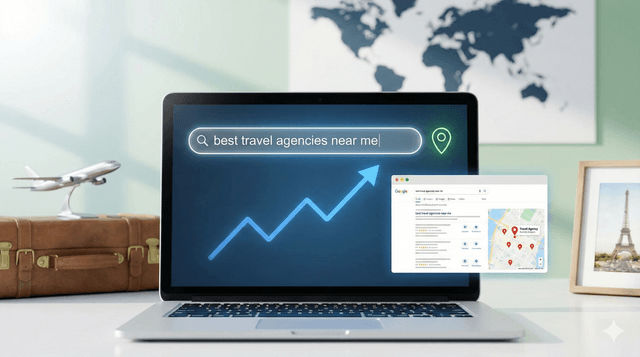
The tourism industry is one of the most dynamic and competitive fields in the world. The digital era has changed the rules of the game for everyone. Among other things, travel is no longer planned by visiting some agency’s office. Like practically everything else, this process now starts in Google’s search bar. According to statistics, more than 90% of travelers look for destinations, hotels, and agencies via the internet. Accordingly, it’s clear that in this reality a travel agency’s success is directly proportional to its online visibility.
Many agencies still pin their hopes on paid advertising (PPC) alone. Although advertising delivers quick results, the moment the budget runs out, your business disappears from the search results.
That is exactly why search engine optimization (SEO) matters. It allows a business to claim a place in the digital world and attract clients without daily advertising costs.
How Do Travelers Find Your Agency in Google’s World?
It’s important to know that SEO isn’t just a set of technical terms. It’s a strategy that makes your agency visible at every stage of a potential client’s “journey.” A traveler’s path to booking goes through several phases: inspiration, planning, and decision-making.
Information Search and Inspiration
Users often search for general phrases like “best places to relax in spring” or “where to go on a honeymoon.” If your website is optimized for such keywords through blog posts, the user will come to you. This is exactly what forms the first connection between brand and customer.
Specific Planning
At this stage the search is more specific, and as a rule people search with phrases like “tours to Kazbegi,” “wine tour in Kakheti,” or “cheap air tickets to Europe.” A well-chosen SEO strategy ensures that your service pages answer these specific queries.
Long-Term ROI
Unlike advertising, whose price rises catastrophically in the tourist season (for example in summer or at New Year), investment in SEO is stable. Optimized content keeps attracting traffic for years, which reduces the cost of each acquired client to a minimum.
Local SEO — How to Attract Visitors “Here and Now”
Local SEO is a decisive factor for the visibility of travel agencies. Imagine a tourist who is already in Tbilisi and searches Google with phrases like “travel agency near me” or “day tours from Tbilisi.” If your business is in first place on Google Maps and in local search results, the chance of a sale is almost 100%.
Local SEO includes several components, which we’ll now look at in more detail.
Google Business Profile — filling out your profile fully and accurately, updating photos, and listing working hours.
Customer Reviews — the more positive reviews you have, the higher Google ranks you in local results. In tourism, trust is everything.
Local keywords — optimizing the site for phrases that include the name of the city or region.
Local optimization lets you compete with big international platforms (for example, TripAdvisor or Booking.com) for a specific geographic location.
Brand Trust and Authority
Travel is connected with emotions, expectations, and financial costs. Customers look for an agency they can trust. Being on Google’s first page is subconsciously perceived as a sign of quality. Customers think: “If this company is in first place, then it’s the best.”
SEO plays an important role in implementing the so-called E-E-A-T principle (Experience, Expertise, Authoritativeness, Trustworthiness). Expert articles on travel tips, safety rules, or hidden locations turn your agency into an industry leader. This trust is directly reflected in conversions — a person more easily buys a tour on the site that gave them useful and comprehensive information.
Technical SEO: Speed and Mobile Adaptation
It’s worth noting that decisions in tourism are often made “on the go.” A tourist trying to book a tour on a smartphone won’t wait more than 5 seconds for the site to load. Technical SEO ensures:
- Site speed — optimized photos (of which there are many on travel sites) and a fast server;
- A Mobile-First approach — since 60–70% of tourist traffic comes from mobile;
- Easy navigation — the user should find and book the desired tour in 2–3 clicks.
If all these criteria are in order on your web page, you’ll get more customers.
10xSEO — Your Partner in Digital Growth
Given the specifics of the travel field, standard SEO approaches are often insufficient. Deep analytics, studying competitors, and knowing market trends are required. This is exactly where professional support is essential.
When it comes to results-oriented digital marketing, we should mention the agency 10xSEO, which helps businesses multiply their organic traffic. As the #1 SEO agency in Georgia, 10xSEO uses international experience and local market knowledge to put a specific business in a leading position in Google’s search engine.
Their approach includes:
- In-depth keyword research — finding the words that bring not just “empty” traffic but real sales;
- A content strategy that answers all of a traveler’s questions;
- A technical audit so that your site is perfectly tuned for Google’s algorithms.
Choose an agency — 10xSEO — and be first.
The Long-Term Advantage of SEO in Tourism
Many agency owners ask: “Why spend time on SEO when I can run a Facebook ad?” The answer is simple: sustainability.
Advertising isn’t a continuous process. SEO, on the other hand, has a “snowball” effect — the more you work on it, the more the result grows, and the harder it is for competitors to take your positions.
SEO lets you maintain visibility even in the “dead season” and prepare for the peak, so that when demand rises, you’re already in first place.
Don’t Delay Action
In tourism, competition is no longer only about service quality; it’s competition for attention. If your potential client can’t see you when searching on Google, your business doesn’t exist for them. SEO is the only way to build a stable, predictable, and profitable client-acquisition system.
Local optimization, technical soundness, and quality content — these are the three pillars on which a travel agency’s digital strategy should be built. Don’t wait for the next season; start optimizing your website today and make your brand the most visible on the tourist map.
If you want to get a detailed action plan and find out which keywords your competitors are beating you on, take a step today. This is what you should do for the success of your business.